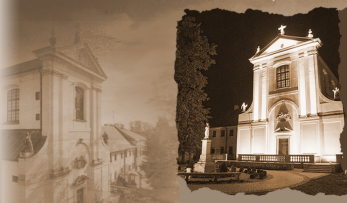
On August 6, behind the monastery, where the entrance to the Museum Exhibition "Węgrów - the place where cultures and religions meet" is located, a press conference was held for the official beginning of the project The twin monasteries: Wegrow and Rava Ruska - using the potential of the heritage of Reformati Order for development of tourism and socio-cultural life in Poland and Ukraine". The project, thanks to which two monasteries will be revitalized, in Węgrów and in Rawa Ruska, Ukraine, is co-financed by the European Union within the cross-border funds "Poland-Belarus-Ukraine 2014-2020."
The guests were greeted by parish priest Dr. Romuald Kosk who, referring to the liturgical feast - Transfiguration of Jesus, emphasized the symbolic tenor of that day, as the Transfiguration of Jesus was also marking the beginning of the revitalization of the monastery. During the conference Maria Koc - Deputy Marshal of the Senate of the Republic of Poland - presented the idea and history of the project. She explained the value the project would bring, both for the local community and for tourists who increasingly visit Węgrów. Andrzej Słodki, the head of the Joint Technical Secretariat Poland-Belarus-Ukraine, who was present at the ceremony, expressed his joy that one of the 17 projects that received funding would be implemented in the Masovian voivodship. Local self-government officials also took the floor: Ewa Besztak - staroste of Węgrów poviat, Paweł Marchela - mayor of Węgrów, Konrad Trzeszczkowski - president of the company ZKM Asis Sp. z o.o. [Ltd.] – the contractor, as well as the representative of the Caritas' partner of the Archdiocese of Lviv, Markiian Stefanyshyn. At the end, a symbolic element was added - the old, dicayed, and dank boards, which were adjoined to the monastery's walls, were dismantled. The conference was also attended by: Anna Kaszuba - head of the Delegation of the Voivodship Office in Siedlce, Marek Renik - deputy staroste of Węgrów poviat, Halina Ulińska - deputy mayor of Węgrów, Roman Postek - director of the Armory Museum at the Castle in Liw, members of the Monastery of Węgrów - the Dialogue Center Association and parishioners.
Project assumptions
The aim of the project, which will last 24 months, is to increase the attractiveness of the cross-border regions (Poland-Ukraine) for tourism through the creation of the Trail of Observance Monasteries, development of dialogue between cultures, mutual youth exchanges, organizing conferences and cultural events and promoting the rule of the Franciscan order - love for the most needy. As a result of the implementation of the project, the number of tourists in border regions will increase, and infrastructure for social, cultural and educational activities will be created to promote the culture and traditions of both countries. The main effects are:
- new cross-border tourist product - The Former Reformati Order’s Monasteries Route;
- promoting the cultural heritage of the Franciscan Observant Fathers;
- 2 revitalized historic monasteries;
- providing recipients with facilities of high artistic and cultural values;
- new functions of monasteries: the Center for Dialogue of Cultures in Węgrów and the Center for Dialogue of Cultures with the Family Children's Home in Rava Ruska;
- developing a dialogue between Polish-Ukrainian cultures through youth exchanges, scientific conferences and cultural events.
At first, the Trail of the Observance Monasteries will include 2 monasteries (in Węgrów and in Rava Ruska) which, due to the project, will be revitalized and will serve new (socio-cultural) functions to meet the needs of local communities and to attract tourists.
In order to create the Center for Dialogue of Cultures and within the scope of revitalization of the monastery in Węgrów, construction works are planned inside the monastery building to adapt it for the purpose of creating 42 sleeping places. Additionally, the interiors will be equipped with: furniture for 14 guest rooms as well as furniture and equipment for the multi-purpose room (for conferences, concerts, film projections, performances, exhibitions) in the patio.
Construction works are planned to create the Center for Dialogue of Cultures, the Family Orphanage in Rava Ruska and to revitalize the monastery in Rava Ruska. It is also within the scope of the project to adjust the monastery for accommodation purposes (12 guest rooms for 24 people) and providing necessary equipment for the Center for Dialogue of Cultures and Family Children's Home. Other rooms that will be created: historical, sports, training and education, as well as recreation and integration room for all persons staying at the Center for Dialogue of Cultures. The Family Children's Home will consist of 4 segments for four families of twelve.
The Monastery in Węgrów
Jan Kazimierz Krasiński (1607-1669), heir to the Węgrów estate, Grand Treasurer of the Crown (1658-1669), on June 27, 1668, declared to the fathers of the Warsaw congregation creating a new foundation in Węgrów. On August 11, 1673, Fr. Tomasz Leżeński/Leżyński h. Nałęcz (approx. 1603-1675), bishop of Łuck (1667-1675), issued a document approving the foundation of the church and monastery in Węgrów. The coronation Sejm in 1674 approved the foundation of the monastery. On May 9, 1675, plots of land were purchased and boundaries were marked. First, a wooden church was erected; it was then followed by a brick monastery. On June 25, 1693, Fr. Paweł Konstanty Dubrawski gave permission for the construction of a brick church. The cornerstone was laid on June 29, 1693.
Construction of the church of Saint Peter of Alkanara and Saint Anthony of Padua was completed in 1705. Probably the royal architect (1672) Tylman from Gameren was the designer (approx. 1632-1706), and the Italian architect Carlo Ceroni was the contractor (approx. 1647-1721). The interior of the church was decorated with a polychrome, which was made in 1706-1711 by Florentine painter, Michelangelo Palloni (1637 - approx. 1713), court painter (1688). On May 26, 1711, the temple was consecrated by Fr. Aleksander Benedykt Wyhowski (1649-1714), bishop of Łuck (1703-1714). On the fifth Sunday after Pentecost, on St. Bonaventure Day, i.e. on July 14, 1715, the construcion was officially completed and the new church was given to the observant fathers by the founder’s son - Jan Bonawentura (Dobrogost), count. Krasiński (1639-1717), voivod of Płock (1688-1717). Simultaneously, a brick monastery was erected in 1706-1715 at the expense of the aforementioned Jan Bonawentura Krasiński.
The Monastery in Rava Ruska
The Observant Fathers settled in Rava in the 1820s. At first, they served in a wooden chapel built in 1725 by Jan Bogusz. The monastery was founded in 1725 by the staroste of Belz, Grzegorz Rzeczyński. Brick monastery buildings and the church of the Archangel Michael was built in 1739 according to the design of Paweł Fontana. Baroque altars were made by the monks Sebastian Wolski and Tomasz Groński, and the 18th century frescoes were made by Jan Ptaszkowski. The fresco in the rainbow ark (in front of the presbytery) is analogous to the one in the Observance Church in Dederkały Wielkie in tarnopolskie voivoship. Unfortunately, it was improperly renovated, but has survived although partly destroyed. The painting depicts the saints Dominic and Francis adoring the Holy Cross. Little is known about the history of this convent. It had not been destroyed by the Austrians. In the years 1907-1909, Father Narcyz Turchan, who died a martyr's death in the Dachau concentration camp, stayed here. In 1999 he was beatified by Pope John Paul II.
photos: Karolina Skibniewska / Catholic Radio Podlasie
|
The Family Orphanage in Rava Ruska |